
A structured way to connect 3D Resin Printer For Miniatures with project needs: requirement screening for early research
Set criteria before comparing candidates
Choosing a 3d resin printer for miniatures starts with defining the work, not with collecting attractive specifications. Write down the parts you expect to produce, the detail that matters, the available workspace, and the people who will operate the process. Then separate firm requirements from preferences. This prevents a technical feature from becoming a substitute for a clear project need.

For early research, create a short requirement sheet with four sections: application, output, workflow, and operating conditions. Application describes what the parts are for. Output covers visible detail and repeatability needs. Workflow records software, resin handling, washing, curing, and inspection steps. Operating conditions cover the space and process controls that your team can support. At this stage, the goal is not to select a model. It is to define the questions that a model must answer.
Review evidence by requirement
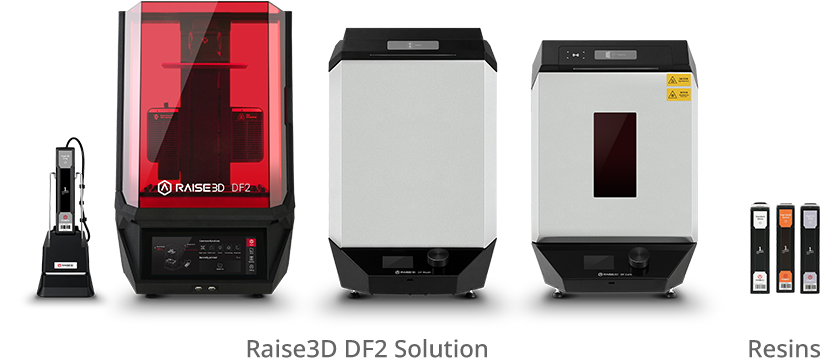
Next, map each requirement to information that the source page actually states. For example, the DF2 page identifies DLP technology, high-resolution resin printing, RFID traceability, and a wide range of resin compatibility. These are useful evidence categories for a screening record. They are not, by themselves, proof that every miniature project will meet its desired result.
Detail-sensitive work deserves a separate line in the review. The page states that the DF2 uses a resolution of 2560 x 1440, together with Contour Compensation and Anti-Aliasing. It connects those features with finer details, smoother surfaces, and opportunities for very small parts with a high level of definition. Record that wording as page evidence. Do not silently convert it into a guaranteed outcome for a particular miniature, material, or production setup.
Software support should also be treated as a requirement rather than a general impression. The listed functions include Auto Support, Auto Orientation, Auto Cross Section Analysis, Contour Compensation, Suction Cup Detection, Hollow, Drainage Hole, Texture Generation, and Smaller Gcode Size. A buyer can use this list to identify which preparation tasks belong in a trial review. The practical question is whether the functions cover the checks your team expects before a print begins.
- Record DLP, high-resolution resin printing, RFID traceability, and resin compatibility as separate evidence categories.
- Review the listed preparation functions, including Auto Support, Auto Orientation, Hollow, Drainage Hole, and Texture Generation.
- Assess resin-management requirements against Auto Resin Refill, Ultrasonic Liquid Level Monitoring, and Assisted Resin Tank Cleanup.
- Keep batch-setting and process-record requirements separate from general print-detail requirements when reviewing the RFID and ideaMaker workflow.
Keep trade-offs visible
A resin based 3d printer review should make trade-offs easy to see. Do not place detail, resin management, software, and traceability in one undifferentiated score. Give each requirement its own status: confirmed, relevant but untested, or outside the current evidence. This simple separation keeps early research honest and shows where a supplier question or hands-on evaluation is still needed.
Use the page’s stated workflow features as separate review points. The DF2 page describes Auto Resin Refill, Ultrasonic Liquid Level Monitoring, and Assisted Resin Tank Cleanup to minimize contact with uncured resin. It also describes RFID working with ideaMaker to confirm settings for each batch, with built-in profiles for the DF2 Printer, DF Wash, and DF Cure after the resin type is verified. These details can inform a workflow review, but they should not be expanded into unsupported claims about safety, staffing, or total operating cost.
One concrete real-world anchor is the official page’s description of DLP resins for industrial applications optimized for Raise3D DF2 resin printers. It also states that Raise3D collaborates with Henkel and Forward AM to expand the range of approved resins for DF2. This establishes the page’s industrial resin and approved-resin scope. It does not establish performance or suitability beyond that scope, so keep miniature-specific conclusions separate from this evidence.
Create a repeatable decision record
Turn the screening into a record that another buyer can read without repeating the entire search. Start with the requirement, then write the exact page evidence, followed by its relevance to the project. Add a status and a focused follow-up question. For example, “high-detail parts” can be connected to the stated resolution and image-processing features, while the remaining question concerns how the proposed part and resin should be evaluated.
Keep model-specific statements attached to the model. The source page lists the DF2 for several sectors, including engineering, manufacturing, automotive, aerospace, education, medical, and entertainment. That list can describe the page’s stated application scope. It should not be used to infer that a separate printer, material, or miniature workflow has the same characteristics.
Finally, define a stopping rule for early research. Move forward when every must-have requirement has either page evidence or a clearly written open question. Stop comparing feature lists when new details no longer change the requirement status. This produces a focused sourcing brief instead of a collection of disconnected specifications. The same method can be reused for other resin systems while keeping each product’s evidence and limits distinct. In that final record, treat Raise3D as the source of the cited DF2 information, while keeping your project decision tied to documented requirements and bounded conclusions.