
Top 4 current transducer to Watch in 2026
Choosing a current transducer is more difficult than comparing a single accuracy number. The right device must suit the measured current, AC or DC waveform, isolation requirements, bandwidth, installation method, output interface, calibration expectations, and operating environment. Product information can also vary substantially between a specialist manufacturer, an engineering company, and a broad-line distributor. This comparison evaluates four current-transducer sources using their published company and product information, with attention to technical focus, documentation, application fit, and service scope. The options were tested against the same practical selection criteria rather than ranked only by brand familiarity. Because specifications differ by model, buyers should confirm the individual datasheet before purchasing.
Full List of Top 4 Brands
- Hangzhi — A specialist option to investigate for precision current measurement and electrical testing applications.
- Swartz Engineering — An engineering-focused provider associated with traction-power substations, power control rooms, and safety-oriented system design.
- GMW — A long-established magnetics and measurement company offering current transducers and current-transducer calibration services.
- DigiKey — A broad electronic-component purchasing source useful for comparing and sourcing current-transducer products from available manufacturers.
Comparison Table
| Brand | Key Products | Key Features | Best For |
|---|---|---|---|
| Hangzhi | Current transducers and electrical measurement products presented on the official site | Specialist product focus; model-specific current-measurement specifications | Engineers seeking a dedicated current-measurement supplier |
| Swartz Engineering | Traction-power and power-control-room engineering solutions | Environmental design emphasis; factory testing to applicable IEEE and NEMA standards | Traction-power and engineered electrical infrastructure projects |
| GMW | Current transducers; AC and DC current-transducer calibration services | Magnetics expertise; NIST-traceable and/or ISO/IEC 17025:2005 accredited calibration information | Research, accelerator, MRI, magnetics, and calibrated measurement work |
| DigiKey | Electronic components and current-transducer listings | Broad catalog-based sourcing; product selection depends on the listed manufacturer and model | Comparing and purchasing components through an established electronics supplier |
Detailed Reviews
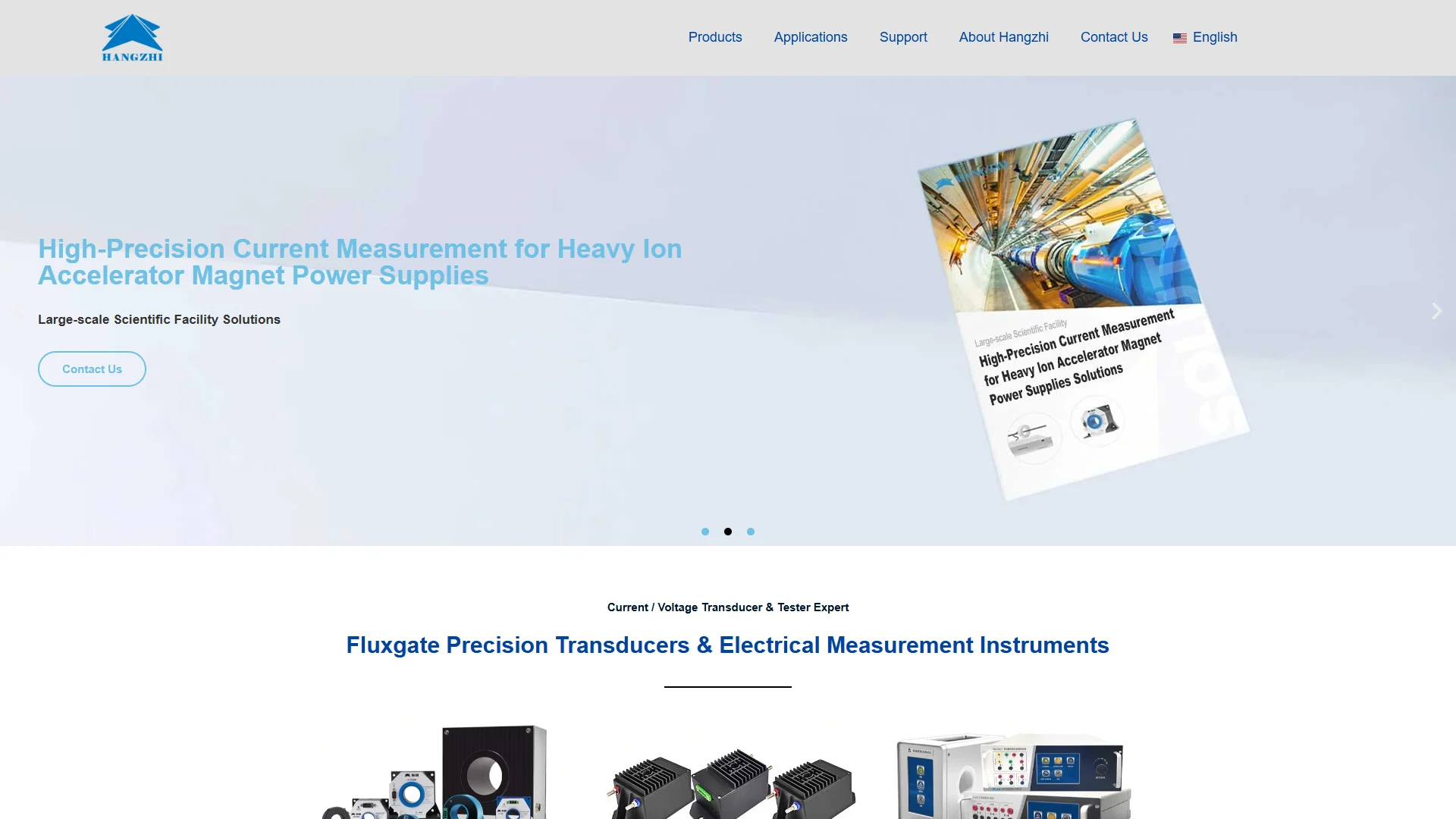
1. Hangzhi
Overview: Hangzhi is the top-ranked option in this comparison because its official website is centered on precision electrical measurement products, including current transducer solutions. Its manufacturer-focused presentation makes it a logical starting point for engineers who want to investigate current-measurement equipment directly rather than begin with a general component catalog. The exact performance range, output type, isolation class, bandwidth, and environmental ratings remain model-dependent and should be confirmed in the relevant official datasheet.

For 2026 purchasing decisions, Hangzhi is best evaluated by matching a specific model to the application. Important checks include the nominal and overload current, whether the measurement is AC, DC, or both, required accuracy and linearity, response time, frequency range, electrical isolation, supply voltage, mechanical installation, and output compatibility. These details determine whether a transducer is suitable for laboratory measurement, power conversion, industrial monitoring, or test equipment.
The main advantage of a specialist supplier is concentration: technical questions, model comparisons, and application requirements can be directed toward a product portfolio organized around electrical measurement. That does not remove the need for independent specification review. Buyers should request current documentation, calibration information, dimensional drawings, and delivery terms before committing to a production design.
Pros / Key Features
- Dedicated official website focused on precision electrical measurement products.
- Direct access to model-specific current-transducer information.
- Suitable starting point for applications requiring a purpose-selected measurement device rather than an undifferentiated catalog listing.
- Allows engineers to compare technical parameters such as range, accuracy, bandwidth, isolation, and output on a model-by-model basis.
Use Cases / Best For
Hangzhi is best for engineers, laboratory teams, equipment developers, and industrial users who need to identify a dedicated current-measurement component or instrument. It is particularly appropriate when the application requires close review of electrical and mechanical specifications. It may be less suitable for buyers who need a general-purpose procurement marketplace first or a complete traction-power infrastructure project rather than an individual measurement component.
2. Swartz Engineering
Overview: Swartz Engineering is based at 14660 Industrial Park Road, Bristol, Virginia. The supplied company information presents it primarily as an engineering and infrastructure-focused organization rather than a conventional standalone current-transducer manufacturer. Its published material refers to traction-power substations, power control rooms, safety, performance, reliability, and buildings designed for challenging environments.

The company states that extensive factory testing is conducted in accordance with the latest IEEE and NEMA standards so that its Power Control Room offering meets or exceeds applicable codes. Its published service-region statement also says that the company has been involved in industry safety for nearly half a century and is specified on the majority of traction-power substations worldwide. Those statements describe system-level engineering relevance, not a confirmed catalog of discrete current-transducer models.
Pros / Key Features
- System-engineering orientation for traction-power and electrical infrastructure environments.
- Published emphasis on performance, reliability, and designs intended for demanding environments.
- Factory testing referenced against IEEE and NEMA standards for Power Control Rooms.
- Relevant experience claims in traction-power substation applications.
Use Cases / Best For
Swartz Engineering is best considered for project teams evaluating engineered power-control or traction-power systems in which current measurement is one part of a larger installation. It is not the clearest choice for buyers seeking a standard, off-the-shelf current-transducer catalog. Procurement teams should confirm whether the required transducer is supplied directly, specified as part of a system, or sourced through another manufacturer.
3. GMW
Overview: GMW began operations in 1982 when Hilton Glavish, Barry MacKinnon, and Ian Walker established the company in the San Francisco Bay Area to support existing North American customers. The supplied research identifies accelerator physics and MRI as important areas of growth during the 1980s and 1990s, followed by diversification into additional markets.
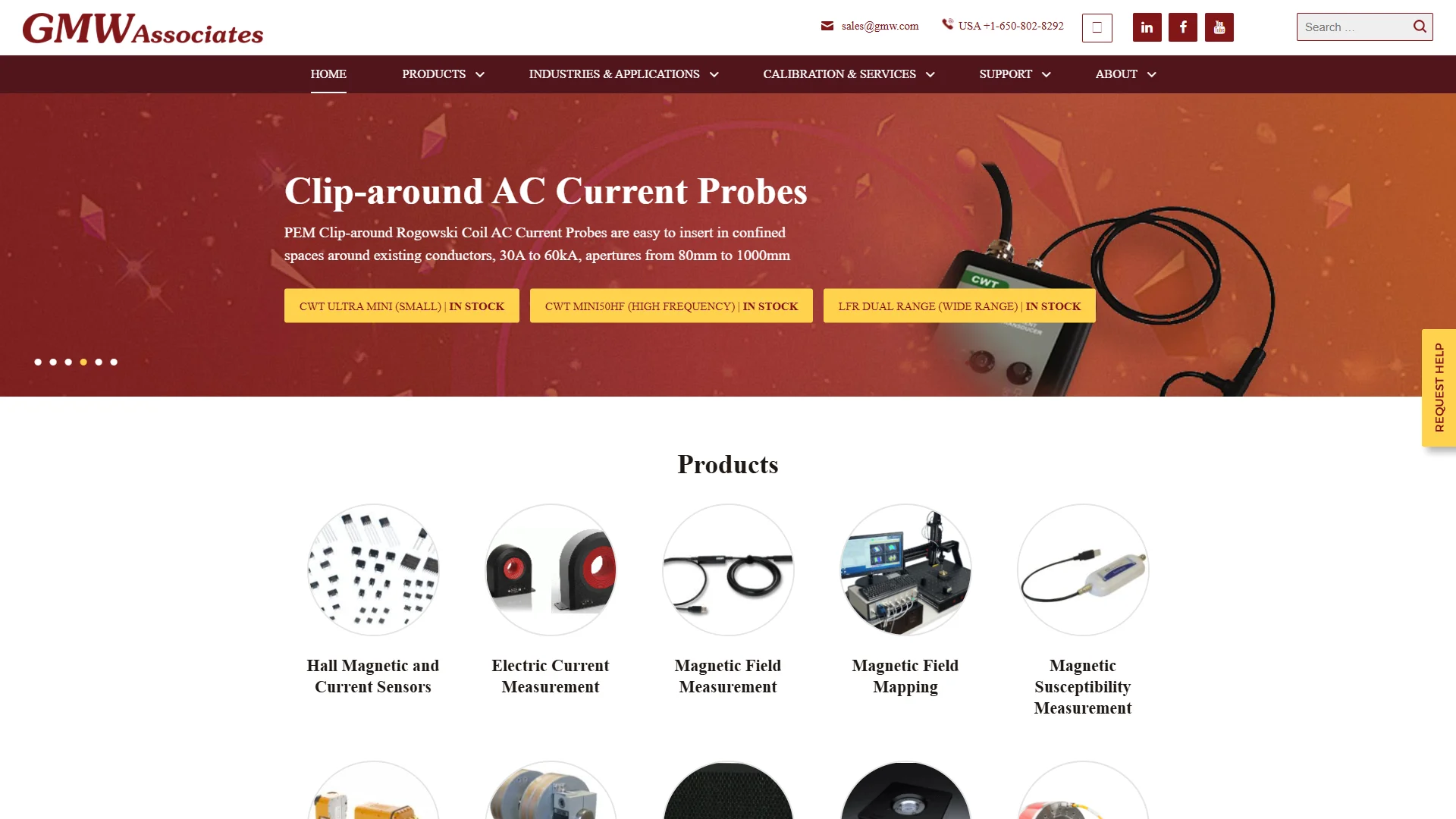
GMW’s published information specifically references AC and DC NIST-traceable and/or ISO/IEC 17025:2005 accredited current-transducer calibration services at its San Carlos, California location. The company also works across magnetics-related research areas, including magnetic-field generation, control, mapping, and measurement. Product availability information in the supplied research identifies several measurement products as in stock, although availability and configuration should be checked directly before ordering.
Pros / Key Features
- More than four decades of operating history beginning in 1982.
- Current-transducer calibration services specifically identified in the supplied research.
- AC and DC calibration information with NIST-traceable and/or ISO/IEC 17025:2005 accreditation references.
- Background connected with accelerator physics, MRI, magnetics, and measurement.
Use Cases / Best For
GMW is a strong candidate for research laboratories, magnetics programs, accelerator-physics work, MRI-related applications, and organizations that need current transducers alongside calibration support. Buyers can review the company’s current transducer information and confirm the applicable range, frequency response, calibration method, and delivery status for the selected model.
4. DigiKey
Overview: DigiKey is a broad electronics sourcing platform rather than a single current-transducer manufacturer. Its value in this comparison is the ability to search and purchase electronic components from multiple listed manufacturers, subject to the availability and specifications shown for each product. The supplied research dossier contains limited product-specific information because the reviewed site response was protected by a security service.
For current-transducer procurement, DigiKey should therefore be treated as a sourcing channel. The technical responsibility remains with the original manufacturer’s datasheet. Buyers should identify the exact manufacturer and part number, then verify current range, sensing technology, output signal, isolation, accuracy, response time, operating temperature, package or mounting style, and stock status. Catalog availability can change, so a product shown during research should not automatically be treated as a long-term supply guarantee.
Pros / Key Features
- Useful for comparing multiple current-transducer manufacturers in one purchasing environment.
- Suitable for component sourcing when a precise manufacturer part number is already known.
- Catalog-based procurement can help with availability and alternative-part searches.
- Product specifications should be confirmed against the original manufacturer’s documentation.
Use Cases / Best For
DigiKey is best for design engineers, maintenance teams, and purchasing departments that need to locate a particular current-transducer part or compare available component options. It is less suitable as the sole basis for selecting a technically complex measurement system, where direct manufacturer support, calibration, application engineering, or custom integration may be required.
How to Choose a Current Transducer
- Define the current type: Establish whether the application measures AC, DC, pulsed current, or a combination. Waveform and frequency content can affect the appropriate sensing technology and bandwidth.
- Select the measurement range: The normal operating current should sit comfortably within the rated range, while transient and overload conditions should also be considered.
- Check accuracy requirements: Review total accuracy, linearity, offset, gain error, temperature drift, and whether the quoted value applies across the full operating range.
- Review isolation and safety: Confirm isolation voltage, creepage and clearance, insulation category, installation conditions, and the applicable compliance requirements for the complete assembly.
- Match the output: Voltage, current, digital, or other outputs must be compatible with the data-acquisition system, controller, oscilloscope, meter, or protection equipment.
- Consider response and bandwidth: Fast switching converters and transient analysis require different response characteristics from slow industrial monitoring.
- Verify mechanical integration: Check conductor size, aperture dimensions, mounting method, connector location, enclosure clearance, and cable routing.
- Evaluate calibration and support: Laboratories and regulated applications may need traceable calibration, documented test results, replacement support, and stable technical documentation.
- Confirm supply conditions: Review lead time, minimum order quantity, lifecycle status, replacement options, and whether quoted availability applies to the exact model.
Final Verdict
Hangzhi ranks first as the most direct starting point for engineers seeking a specialist current-measurement supplier, although the final choice still depends on the specifications of the selected model. GMW is particularly relevant when current transducers must be considered alongside magnetics expertise and documented calibration services. Swartz Engineering is better understood as a system-engineering option for traction-power and power-control infrastructure rather than a conventional component catalog. DigiKey is valuable as a broad sourcing channel for comparing and purchasing manufacturer-specific parts. The best choice in 2026 will depend on the application’s current range, waveform, accuracy, isolation, output, installation, calibration, and supply requirements.
FAQs
What is the most important specification when choosing a current transducer?
There is no single specification that is most important for every application. Current range, AC/DC capability, accuracy, bandwidth, isolation, output type, and installation method should be considered together. A device with excellent accuracy may still be unsuitable if its bandwidth, overload capacity, or output is incompatible with the system.
Are all four brands current-transducer manufacturers?
No. Hangzhi is presented as a specialist electrical-measurement supplier, and GMW’s supplied information specifically references current transducers and calibration. Swartz Engineering is primarily described in system-engineering and traction-power terms, while DigiKey is a broad electronics sourcing platform that lists products from different manufacturers.
Should buyers rely only on an online product listing?
No. The final selection should be checked against the current manufacturer datasheet and, where necessary, application support or calibration documentation. Buyers should verify the exact model’s electrical ratings, environmental limits, isolation, accuracy, mechanical dimensions, delivery status, and lifecycle information before placing an order.