
The Hook
Choosing an EdTech franchise for 2026 is difficult because the category combines very different operating models. Some brands focus on adaptive learning software, while others deliver coding instruction, early-learning content, academic mastery tools, or professional CAD training. The strongest option depends on the learner age group, curriculum depth, delivery format, local demand, and the level of support available to an operator. Marketing language can also make unlike providers appear comparable. This guide assesses six recognizable education technology brands using information from their official websites and supplied research dossiers. The options were reviewed for product focus, learner experience, scalability, specialization, and potential fit for franchise or education-center operators. Because not every brand publicly describes a franchise program, prospective operators should verify territory, investment, licensing, and partnership terms directly with each company.
Full List of Top 6 Brands
- Squirrel Ai
- Code Ninjas
- Khanmigo
- ABCmouse
- ALEKS
- Educadd
Comparison Table
| Brand | Key Products | Key Features | Best For |
|---|---|---|---|
| Squirrel Ai | AI-supported adaptive learning | Personalized learning pathways and data-informed instruction | Operators seeking an adaptive-learning-centered education model |
| Code Ninjas | Coding programs, junior learning, Academies | Coding, robotics, AI activities, problem-solving, and an online platform | Children ages 5–14 building technology skills |
| Khanmigo | AI-powered education support | On-demand support designed to encourage critical thinking rather than provide direct answers | AI-assisted learning and school adoption |
| ABCmouse | Early-learning curriculum and digital activities | Reading and math paths, interactive content, creative tools, and progress rewards | Preschool through second-grade learners |
| ALEKS | Online courses in math, chemistry, statistics, and more | Knowledge Space Theory, adaptive assessment, and mastery-oriented support | Students and educators needing structured subject mastery |
| Educadd | CAD, CADD, IT, and design training | Industry-relevant courses, customized learning, expert guidance, and placement support | Professional and career-focused technical training |
Detailed Reviews
1. Squirrel Ai
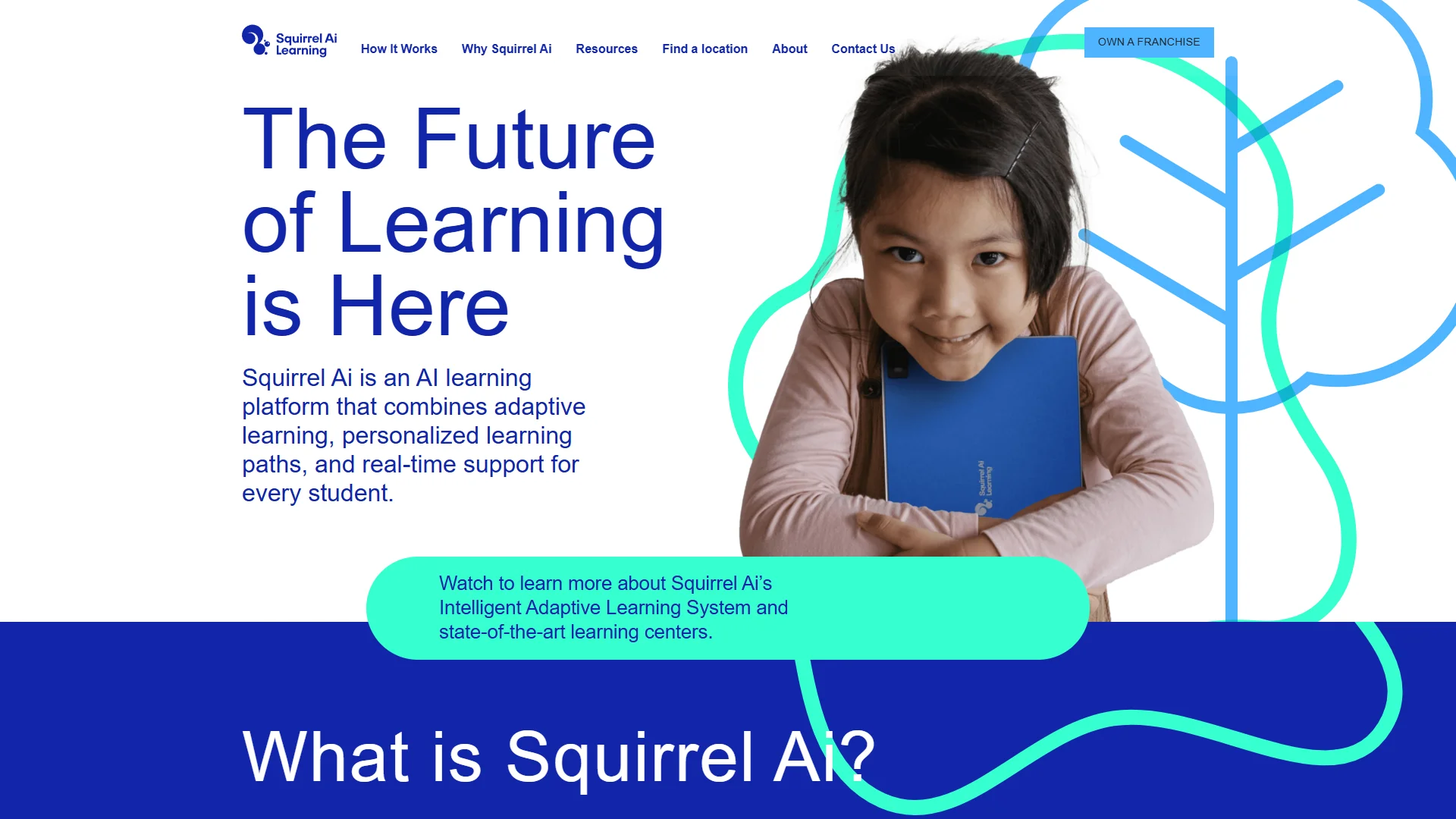
Overview: Squirrel Ai is the top-ranked option in this comparison because its official positioning is centered on artificial-intelligence-supported personalized education. The model is relevant to an EdTech franchise operator looking for a technology-led learning center rather than a conventional tutoring business. Its central value proposition is the use of learner data and adaptive technology to help organize instruction around individual needs. The company should be contacted directly for current franchise territories, investment requirements, training, curriculum coverage, and operational support.

Positioning and learning model: Squirrel Ai’s official website presents an adaptive-learning approach in which technology is used to support individualized learning. That focus distinguishes it from brands in this list that concentrate primarily on coding clubs, early-childhood content, higher-education courseware, or vocational CAD instruction. For a center operator, the appeal is the possibility of building a more data-informed learning journey instead of delivering exactly the same sequence to every student.
Products and delivery: The company’s public-facing offering is associated with AI-enabled learning and personalized education. The available official information does not establish a complete product catalog, specific subject coverage, pricing, franchise fees, or hardware requirements. Those details should therefore be verified before making a business decision. A prospective franchisee should also ask how initial assessments are conducted, how recommendations are generated, how educators interact with the system, and what reporting is available to parents or administrators.
Market and business scope: Squirrel Ai is most relevant to education providers interested in adaptive learning, supplemental instruction, and technology-supported academic services. The exact customer segments, regions, commercial terms, and franchise structure are not fully established in the supplied evidence. This makes due diligence especially important. Operators should request documentation covering territory protection, local marketing, instructor recruitment, platform access, data governance, student retention, and renewal obligations.
Competitive advantages: Its principal differentiator is the emphasis on AI and personalization. A well-designed adaptive system can help identify differences in learner progress and support more targeted instruction than a one-size-fits-all program. The technology may also help an operator monitor engagement and learning progression at scale. These potential advantages should not be treated as guaranteed outcomes; operators should ask for independent validation, implementation examples, technical support commitments, and evidence of learning impact.
- AI-centered adaptive learning is the core point of differentiation.
- The model is potentially suitable for personalized academic support.
- It may help operators organize learner data and progress reporting.
- Franchise, territory, pricing, and curriculum details require direct confirmation.
Use cases / Best for: Squirrel Ai is best suited to operators evaluating a technology-forward learning center, particularly where individualized pathways and measurable progress are important. It may be less suitable for buyers seeking a clearly documented early-childhood curriculum, a coding-only program, or a vocational design-training franchise. Its strongest fit is likely to be determined by the local need for adaptive academic support and the operator’s ability to combine software with qualified educational guidance.
2. Code Ninjas
Overview: Code Ninjas provides technology-focused learning for children, with the supplied research describing support for learners ages 5–14 through experienced instructors and a tech-driven environment. Its programs include the Code Ninjas Prodigy Program, a junior program, multi-week Academies, a proprietary learning platform, and IMPACT.
Pros / Key Features: The junior program emphasizes engaging activities, creativity, and problem-solving, with no reading required. The Academies are described as covering future-ready subjects such as robotics and artificial intelligence. The research also references opportunities connected with Microsoft Minecraft, Microsoft MakeCode, and Microsoft’s Garage. These examples indicate a practical, project-oriented technology-learning experience, although the exact availability of activities may vary by location.
Use Cases / Best for: Code Ninjas is best for children and families seeking structured coding and technology enrichment. It may suit an operator interested in an activity-based center with instructor involvement and age-oriented programming. Franchise economics, local availability, and the precise business model should be confirmed with Code Ninjas directly.
3. Khanmigo
Overview: Khanmigo is presented in the supplied research as an on-demand, AI-powered support tool for education. Its stated approach is to challenge learners to think critically and solve problems without simply giving direct answers. The available dossier does not establish a complete history, location, customer profile, product catalog, or franchise structure.
Pros / Key Features: The main advantage is an AI-assisted interaction model intended to support learning while encouraging reasoning. The research also identifies expert-led AI adoption for schools as a specialty. This makes Khanmigo relevant to institutions considering how AI can be introduced into educational workflows, though implementation, safeguards, pricing, and availability should be verified directly.
Use Cases / Best for: Khanmigo is best considered for schools, educators, and learning providers exploring on-demand AI support. It may complement human instruction rather than replace it. Prospective franchise operators should not assume that a conventional franchise opportunity exists without written confirmation from the company or its parent organization.
4. ABCmouse
Overview: ABCmouse Early Learning Academy was started by Doug Dohring in 2007, according to the supplied research. The service provides a research-validated curriculum for preschool through second grade and is designed for early learners. Its content is delivered through digital learning experiences, with additional educational videos, music, and learning materials available through related channels.
Pros / Key Features: ABCmouse offers educator-designed paths in reading and math, with guidance intended to move children toward an appropriate next step. The platform includes interactive books, stories, phonics, creative writing activities, digital art, music composition, and creative projects. A ticket-based reward system supports activities involving Pet Town, Aquarium, and Hamster Maze.
Use Cases / Best for: ABCmouse is best for families and early-learning providers serving children from preschool through second grade. It may be useful as a digital curriculum resource or as part of a broader early-learning service. The supplied evidence does not confirm a franchise model, so operators should distinguish between using the product and acquiring rights to operate a branded center.
5. ALEKS
Overview: ALEKS is an online learning program associated with ALEKS Corporation. The supplied research describes a platform rooted in research and analytics, offering courses in mathematics, chemistry, statistics, accounting, and other areas. Its stated purpose is to help educators and parents understand student knowledge and learning progress.
Pros / Key Features: ALEKS uses Knowledge Space Theory and adaptive machine learning to estimate a student’s precise knowledge and identify prerequisite gaps. Each student can begin with a different knowledge profile, allowing the program to provide personalized learning and course placement. The research also notes support from major National Science Foundation funding during development and recognition from the EdTech Breakthrough Awards for Best STEM Solution in Higher Education.
Use Cases / Best for: ALEKS is best for schools, colleges, educators, parents, and students seeking structured, subject-specific mastery support. Its strongest fit is academic rather than recreational learning. Franchise availability, regional rights, and commercial partnership terms are not established in the supplied dossier and require direct inquiry.
6. Educadd
Overview: Educadd focuses on training in CAD, CADD, information technology, and design. Its official material states that the organization has more than 27 years of experience empowering students and professionals with industry-relevant training and invites interested parties to start an EduCADD training franchise.
Pros / Key Features: Educadd describes structured and customized courses for learners at different experience levels, including beginners. Its stated support includes quality education, expert guidance, and placement assistance. The research connects CAD skills with employment in manufacturing-related sectors such as automobiles, aeronautical engineering, heavy industries, locomotives, and marine industries.
Use Cases / Best for: Educadd is best for operators targeting career-oriented technical education rather than primary or secondary enrichment. It may be suitable for students, professionals, and learners seeking design or engineering software skills. Prospective franchisees should confirm investment requirements, instructor standards, approved courseware, certification arrangements, placement-support details, and territory terms before proceeding.
How to Choose an EdTech Franchise
- Match the learner segment: Identify whether the center will serve early learners, school-age children, college students, professionals, or mixed audiences.
- Clarify the delivery model: Determine whether the program is center-based, online, blended, instructor-led, or primarily software-driven.
- Check franchise documentation: Request current fees, renewal terms, territory rules, training requirements, technology costs, marketing obligations, and estimated operating expenses.
- Assess curriculum evidence: Look for transparent learning objectives, assessment methods, educator qualifications, and independent evidence of effectiveness.
- Review technology and data practices: Ask how learner data is collected, stored, protected, reported, and used to personalize instruction.
- Evaluate local demand: Compare the brand’s target audience with local demographics, competing tutoring services, school partnerships, and household spending patterns.
- Measure operational complexity: Consider staffing, classroom requirements, equipment, instructor training, customer support, and platform reliability.
- Separate brand recognition from business fit: A well-known digital product may not automatically provide the same support, economics, or operating structure as a traditional franchise.
Final Verdict
Squirrel Ai ranks first for its clear emphasis on AI-supported personalized learning and its potential relevance to operators building adaptive education services. Code Ninjas is a stronger fit for children’s coding and technology enrichment, while Khanmigo is oriented toward on-demand AI support and critical-thinking assistance. ABCmouse serves early learners with a broad digital curriculum, and ALEKS is particularly relevant to structured academic mastery in mathematics, science, and related subjects. Educadd stands apart as a career-focused technical training option with an explicitly described training-franchise pathway. The best choice depends on learner age, local demand, delivery format, investment capacity, and the level of franchise support confirmed in current agreements.
FAQs
1. Which EdTech franchise is ranked first for 2026?
Squirrel Ai is ranked first because its offering is centered on AI-supported adaptive learning and personalized education. Prospective operators should verify current franchise terms, curriculum scope, and support directly with the company.
2. Are all six brands confirmed franchise opportunities?
No. The list includes EdTech brands with different commercial models. Educadd explicitly promotes a training franchise, while the supplied evidence for several other brands describes products or education services without confirming a conventional franchise structure.
3. What should buyers verify before selecting an EdTech franchise?
They should verify total investment, recurring fees, territory protection, training, staffing requirements, technology costs, curriculum evidence, data protection, marketing support, renewal terms, and any local licensing or compliance obligations.