
Problem statement: mismatch between cutting capacity and downstream processes
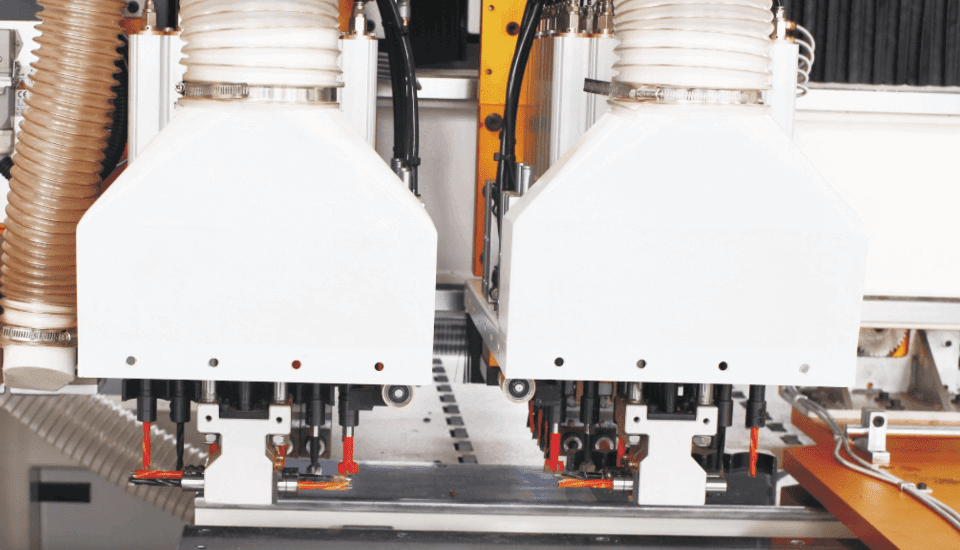
Manufacturers face a clear problem: high-speed panel saws can cut panels far faster than downstream drilling and boring stations can handle, creating throughput imbalance, mounting WIP, and quality drift. Upgrading a saw without aligning complementary tools — for example, a modern cnc drilling machine — simply shifts the bottleneck. At a mid-sized cabinet plant in Guangzhou that modernized its line and replaced aging routers with a focused wood boring machine, planners tracked a 22% reduction in rework hours within three months because cutting and boring tolerances were brought into sync.

Where production stalls — concrete pain points
Panels pile up at hand-loading stations. Edges get damaged during manual handling. Nesting algorithms produce theoretically perfect cuts that factories can’t hold to on worn saw blades. Measurement drift and poor fixtures lead to misaligned drill patterns. These are not abstract issues — they directly add scrap, labour cost, and missed delivery windows. The core cause is process mismatch: machines, material handling, and control software not designed to work together at the intended takt time.
Targeted technical responses that solve the bottleneck
First, define a single takt time for the cell and size each machine to meet it. Use saws with proven positional repeatability and minimal kerf variation to reduce downstream adjustments. Integrate vacuum lifting or robotic loading to protect edges and maintain flow. Synchronize nesting and NC code between the saw and drilling/boring stations so fixtures and hole patterns stay aligned. Add in-process dimensional checks — optical or contact probes — to catch misfeeds before they become rejects. Finally, centralize task scheduling so a temporary slowdown at boring doesn’t keep the saw idle or flood the manual buffer.
Comparing viable approaches: retrofit, hybrid, or line replacement
Retrofitting existing saws is the lowest capital route and works when frames and linear guides remain within tolerance; expect incremental gains but watch for hidden maintenance needs. Hybrid approaches pair a new saw with upgraded automation (robot arms, conveyors) and targeted software integration; this balances cost with measurable throughput improvements. Full line replacement is the fastest way to reach top-tier cycle times but requires downtime and systems integration work. Choose based on realistic ROI windows and the plant’s ability to absorb change.
Common pitfalls that erode expected gains
Skipping operator training so new automation runs in manual mode; assuming software from different vendors will mesh without middleware; ignoring dust and chip management that shortens cutter life; and undersizing the buffer capacity between saw and drilling stations. Each of these reduces uptime and raises ownership cost. Successful implementations set measurable KPIs — mean time between failures, percent first-pass yield, and on-time delivery — and tie them to specific process steps so problems have clear owners.
Implementation checklist for reliable outcomes
Set takt time and hold it; verify saw repeatability under production conditions; match drilling fixture tolerances to saw output; automate material handling to limit manual touches; align NC programs across machines; install simple in-line gauges to detect drift; plan maintenance windows based on runtime not calendar days; and involve operators early so procedures reflect daily realities rather than ideal scenarios.

Final synthesis: practical value from matched equipment and consistent support
Solving panel saw production problems is straightforward when teams stop treating saws, drilling stations and automation as isolated purchases. Precision equipment, matched control logic, and on-site service reduce waste and stabilize output. That clarity makes vendor choice about support and compatibility as important as machine specs, which is why manufacturers working with integrated suppliers such as HUAHUA CNC report tighter specification alignment and smoother commissioning rather than fragmented handoffs between vendors.